The Plan: Safety. Economy. Family.
(What I Stand for — and the Evidence Behind Each Word
Safety for All So Everyone Can Achieve Their Best Life
A city where everyone can move safely — on foot, on wheels, in a wheelchair.
In practice: pedestrian safety on shared paths; sensible e-scooter rules; better crosswalk lighting; safety and lighting audits; RCMP and community partnerships.
We can be a green city and a safe one.
Economy
A confident local economy that decides its own future — instead of waiting.
In practice: an economic development vision for the old ICBC site — community hub, cultural centre, housing and a business centre; getting traffic and growth decided together; backing small business and the BIAs.
Traffic and Congestion
Congestion is an economic problem before it's anything else. Every hour in gridlock is an hour not worked, not spent locally, not at home.
The North Shore has added tens of thousands of people since 1960 and is still served by the same two crossings. No councillor can change that. The province builds bridges and funds rapid transit, and pretending otherwise at election time is how candidates lose trust.
What a councillor can do is stop making it worse and keep the pressure on. I'd put a named transportation ask on the record at every major rezoning, so growth and the infrastructure to carry it are decided together rather than years apart. And I'd oppose any net reduction in road capacity on the corridors feeding the bridges until there's a funded, dated transit alternative — not a plan, a date.
Family
A city families of all kinds and sizes can afford to stay in.
Housing: help thousands, not hundreds.
North Vancouver has some of the highest rents in the country. When the City commits major public value to housing, the test should be simple: does it help the most people, across the most neighbourhoods, as effectively as possible?
I’d use the City’s full toolkit instead of betting everything on a single mega-site: lease or monetize city land where it makes sense — as the City did with the Harry Jerome lands — stack federal and provincial grants, borrow prudently through the Municipal Finance Authority, and partner with non-profits. The same public investment, spread further.
That approach still delivers the community assets we need — a new Neighbourhood House and respite care, built efficiently — while also preserving existing affordable rentals before we lose them, offering direct rent relief to families and workers, building several smaller mixed-income projects across our neighbourhoods, and easing the costs that squeeze families hardest, like childcare and utilities.
Affordable housing isn’t one building. It’s a strategy.
Also part of Family: development-fee reform; strata renewal; and honest finances — smart spending, a debt dashboard, a reserve-floor policy — instead of betting the city on a real estate gamble.
We can grow smart — not expensive.
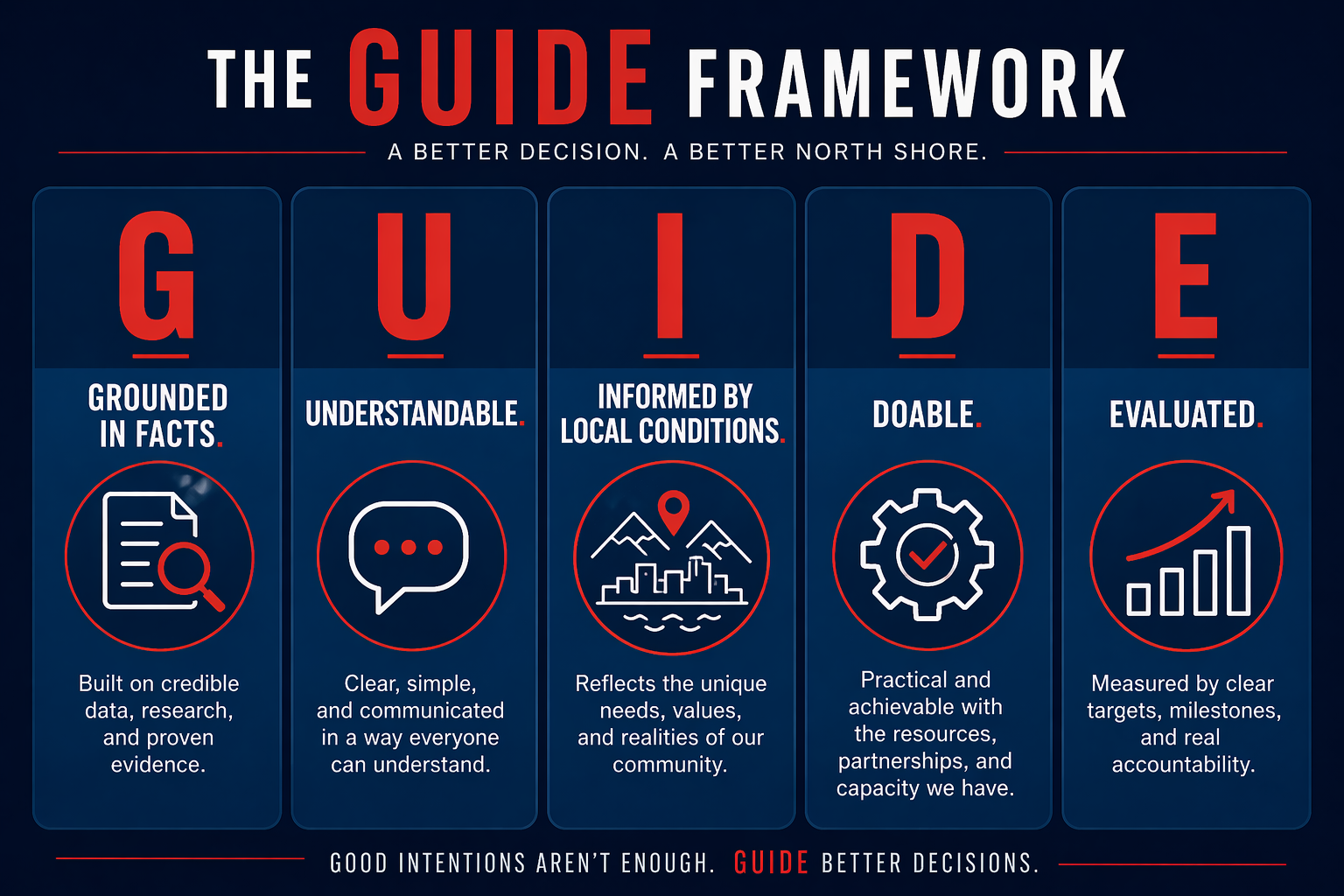
How I decide: the GUIDE test
The GUIDE Test is my simple framework for evaluating major public decisions. Every proposal should be Grounded in evidence and common sense, Understandable and transparent to the public, Inclusive of the whole community, Doable within the city's financial and operational capacity, and Evaluated against clear, publicly reported results. If a proposal can't pass those five tests, it needs more work.